Customer retention · 6 min read
Post-purchase email flow: a practical path from the first order to a relevant second purchase
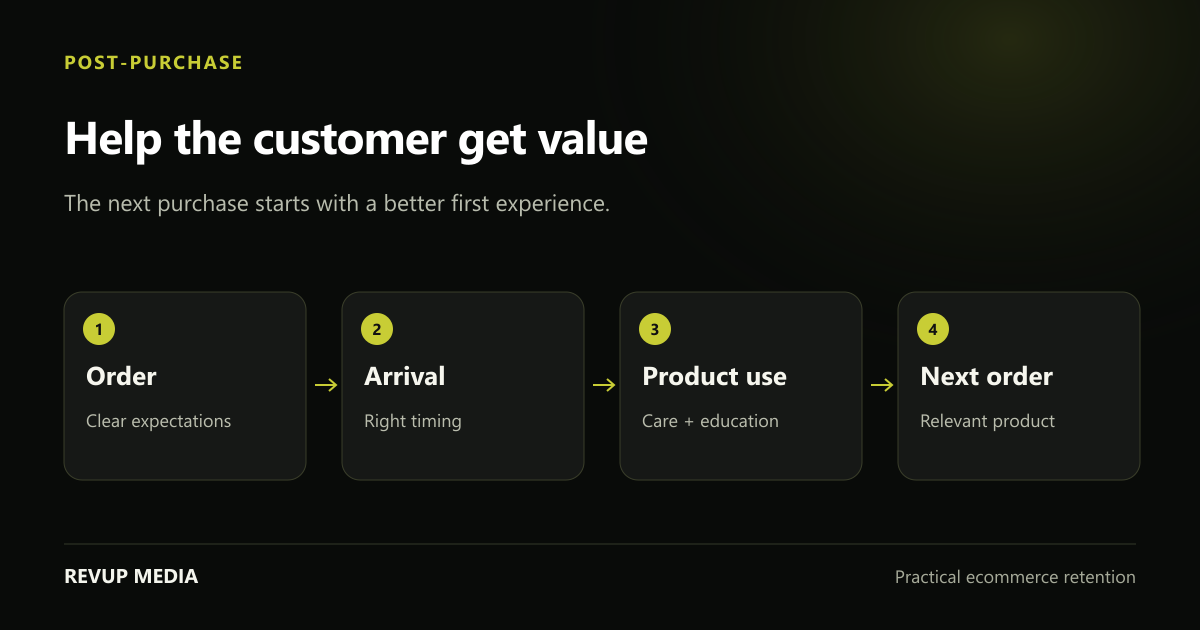
A post-purchase email flow should help the customer get value from what they just bought before asking them to buy again. Good timing depends on fulfilment, product use and the next genuinely relevant purchase.
Start here
Build around customer readiness. Order placement, dispatch, delivery and product use are different moments, and your emails should not treat them as interchangeable.
Separate essential order messages from marketing
Inventory confirmation, payment, shipping and delivery messages already sent by Shopify, carriers, subscription tools or other systems. These messages provide essential service information. A promotional journey should complement them rather than duplicate or contradict them.
Decide which system owns each step and which messages require marketing eligibility. Do not casually label a promotional message transactional to send it to more people. Follow the provider’s process and applicable channel rules when configuring message type.
Sketch the customer’s first days after ordering. What do they know? What are they waiting for? What can they do before the product arrives? That map is a better starting point than a list of cross-sell products.
Use the event that matches the message
Placed Order can start a thank-you or preparation journey. Product-use education may need to follow delivery or an appropriate delay. A review request should arrive after the customer has had a realistic chance to experience the product.
Check what your integration actually provides. If you do not have reliable delivery events, do not write copy that assumes delivery is confirmed. Use careful language and a delay informed by fulfilment history, or route the customer to their order status for specifics.
Klaviyo supports post-purchase journeys with purchase triggers, delays and customer splits. Preview first-time and repeat-buyer paths, and consider fulfilment messages elsewhere in the stack. The mechanics should support the customer stage rather than determine it by convenience.
Source and context: Klaviyo: creating a post-purchase flow ↗. Klaviyo documents purchase triggers, time delays and customer splits. Match your own content to available fulfilment data and the customer’s realistic time to use the product.
Make education specific to the product
Useful onboarding removes a practical source of friction. A linen product may need care guidance. A supplement may need accurate directions taken from approved product information. A device may need setup and compatibility help. The question is what makes the customer more confident using their purchase.
Keep each message focused. A short guide to one common problem can be easier to act on than a full manual reproduced inside the email. Link to a complete resource when needed, and make the key instruction readable without depending entirely on images.
Use product-level context only when it is reliable. Test mixed orders and category overlap. If the customer buys two products, a single appropriate education path may be better than several simultaneous messages. Add fallback content for purchases that do not fit a specialised branch.
| Stage | Useful message | Readiness check |
|---|---|---|
| After order | Thank-you and accurate next steps | Order accepted and message ownership clear |
| After arrival or suitable delay | Setup, care or first-use guidance | Delivery evidence or careful timing |
| After enough use | Feedback or review invitation | Realistic chance to experience the product |
| At a relevant next moment | Complementary item or replenishment | Product fit and purchase-cycle evidence |
Ask for feedback when it can be meaningful
A review request arriving before delivery is both unhelpful and a sign that the brand is not paying attention. Align the request with actual experience. For a product that takes longer to evaluate, allow more time than you would for a simple item used immediately.
Make it easy to ask for help as well as leave feedback. A customer with an issue may need a service route rather than a promotional follow-up. Coordinate open support concerns where your tools and data support that approach.
Do not invent reviews, imply every customer is delighted or conceal genuine limitations. If you offer an incentive for feedback, use an approved approach and describe it honestly. The goal is to learn and provide useful support, not force a positive rating.
Choose the second-order angle from the first purchase
A relevant next product should have a clear connection to what the customer owns or wants to do. An accessory that improves use, a complementary category or a replenishment item can make sense. A generic catalogue sale is less useful when the brand already knows the purchase context.
Avoid recommending the same item again without a reason. Durable products and consumables have different repeat-order patterns. Use observed time between orders and category behaviour to plan timing; do not assume every product needs a 30-day reminder.
For Black Friday buyers, check whether the next order is likely to depend on another discount. Education and product fit can create a reason to return without extending seasonal price expectations indefinitely. If a benefit is included, calculate its contribution and explain the terms clearly.
Measure retention on a realistic horizon
Inspect delivery, clicks and attributed orders for the messages, then evaluate customer outcomes over time. Track the share of eligible first-time buyers who place another order within a period suited to your product. Compare cohorts with similar acquisition and seasonal context where possible.
A short-term email revenue report will not fully describe the value of education or service. Support contacts, product returns and later repeat buying can add context, although those changes cannot automatically be attributed to one email. Be explicit about what is observed and what remains uncertain.
Use the results to change the journey. If review requests arrive too early, adjust the event or delay. If cross-sells receive clicks but poor orders, inspect recommendation fit and landing pages. If several messages crowd the first week, reduce overlap. Retention work is strongest when it improves the customer’s experience of the product.
- Confirm order and fulfilment ownership across tools.
- Test first-time, returning and mixed-product paths.
- Align review and cross-sell timing with actual readiness.
- Review second-order behaviour beyond the immediate sale window.
Common questions
When should I send a post-purchase cross-sell?
When the next product is relevant and the customer is ready to consider it. Use fulfilment, product use and buying-cycle evidence rather than a universal day count.
Should Black Friday buyers receive a different post-purchase flow?
Only when their offer, expectations or onboarding needs differ meaningfully. You can adapt content without creating a separate journey for every seasonal customer.
Need a plan for your store?
Turn the next useful idea into action.
We review your campaigns, flows, signup experience and customer journey to identify the work worth doing first.
Book Your Free Audit →Build a connected automation strategy →