Black Friday · 7 min read
Black Friday email marketing strategy: a practical 2026 playbook for ecommerce
A strong Black Friday email marketing strategy gives each subscriber a useful reason to buy, each campaign a clear audience, and each offer a margin you can live with. Start with the customer journey, then build the sending calendar around it.
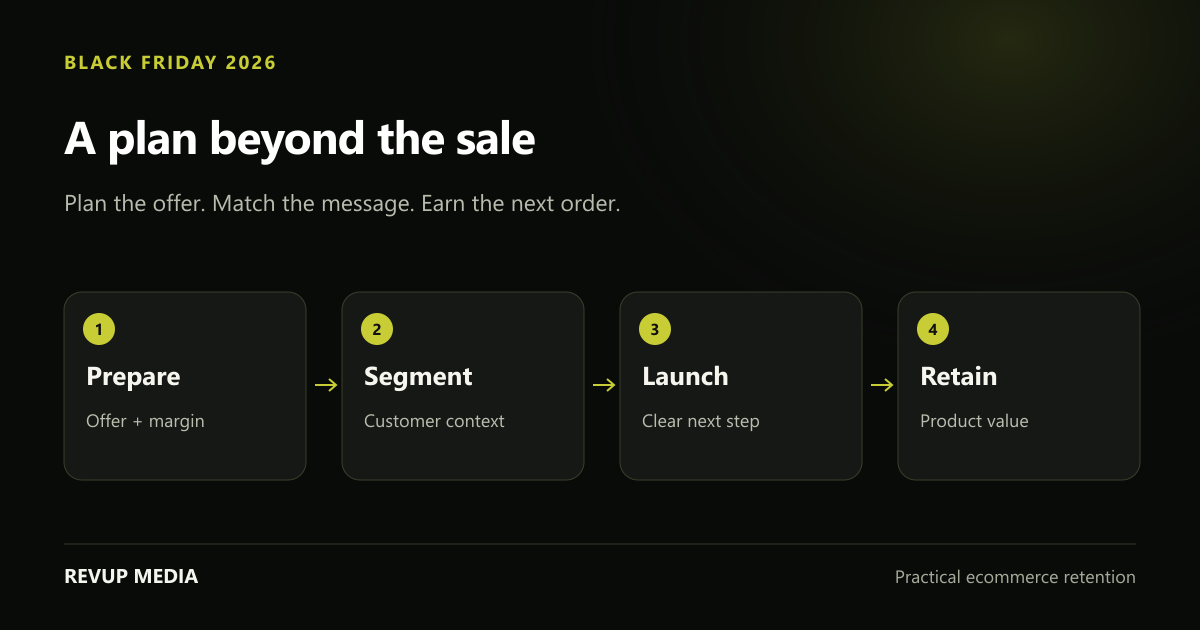
Start here
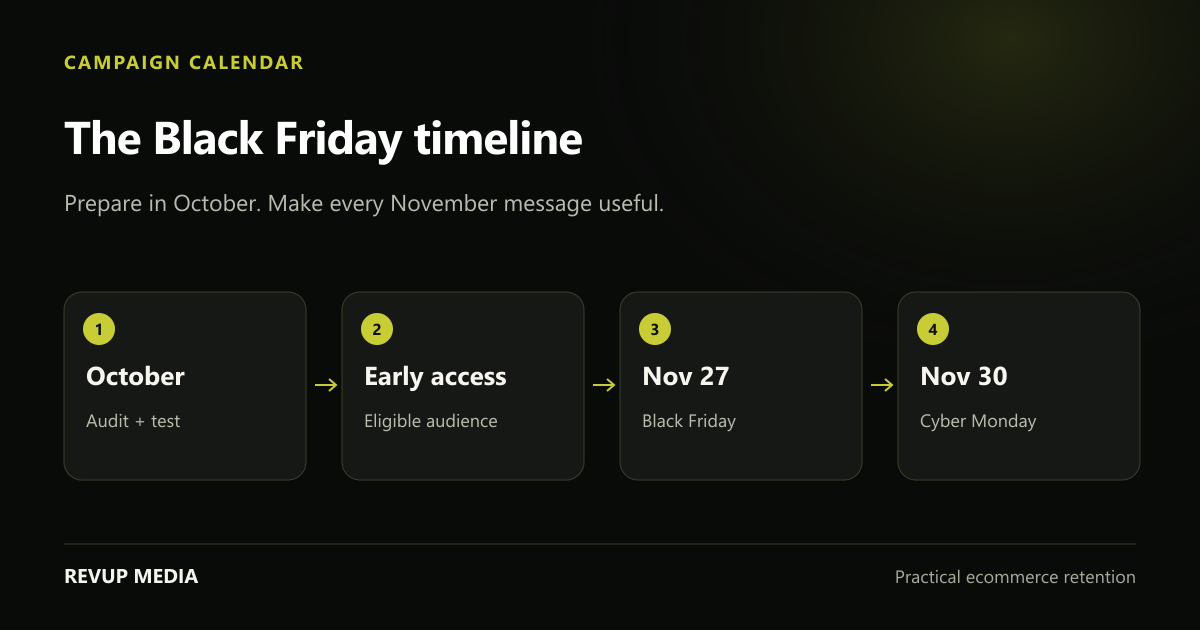
Plan the offer and exclusions before writing emails. Black Friday is November 27, 2026; Cyber Monday is November 30. Your campaign dates can differ, but your deadlines must be explicit.
Define the outcome before choosing the discount
Write down the commercial goal in one sentence. Are you trying to acquire first-time buyers, increase average order value, move a specific inventory group, or give existing customers a reason to reorder? A campaign trying to do all four usually becomes a generic sale announcement.
Build an offer sheet with the eligible products, audience, minimum spend, discount rules, shipping terms and expiration time. Include the time zone. Then calculate contribution per order after product cost, discount, fulfilment, payment fees and any gift. A large attributed-revenue number does not tell you whether the offer is healthy.
For an illustrative order worth $100 before discount, a 20% reduction leaves $80. If product cost is $35 and variable fulfilment and payment costs total $12, contribution is $33 before acquisition costs and overhead. Changing the headline discount changes that contribution immediately. Use your actual costs and returns assumptions before approving the campaign.
- Choose one primary commercial goal and one customer benefit.
- Confirm stock, coupon exclusions and whether offers stack.
- Assign an owner for offer changes and a person who can pause a send.
Build audiences that change the message
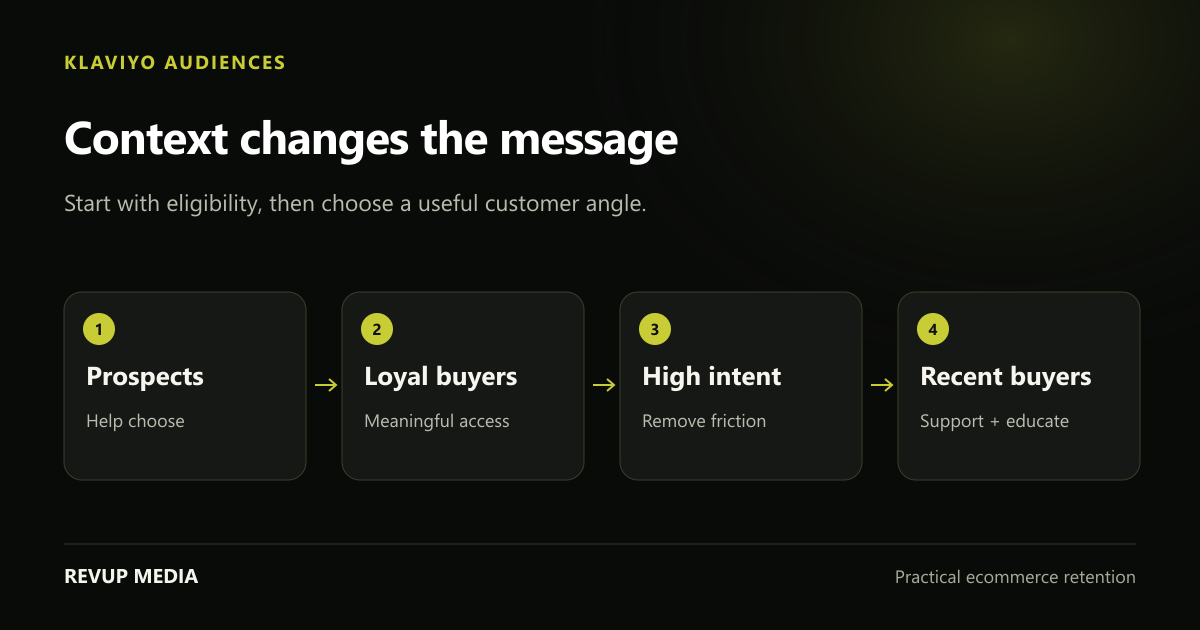
Start with consent and eligibility, then add customer context. A subscriber who has never ordered needs help choosing. A repeat buyer may value early access or a relevant bundle. A recent purchaser may need reassurance and product guidance rather than another acquisition discount.
Use clicks, purchases and available site activity alongside engagement history. Opens alone can be noisy because inbox privacy features may pre-load tracking pixels. Document exactly what each segment includes and what it excludes. Check overlap before you schedule multiple campaigns.
Create one shared suppression approach for unsubscribed contacts, people who are not eligible for the channel, and customers whose current situation makes the message inappropriate. A customer waiting on an unresolved delivery issue may need service first. Segment size should be checked again near send time because a dynamic audience can change.
| Audience | Useful angle | Avoid |
|---|---|---|
| New, engaged subscribers | Best starting products and clear sale terms | Assuming they know the range |
| Repeat buyers or VIPs | Early access, relevant bundles, replenishment | The same introduction every send |
| Recent purchasers | Useful onboarding and complementary products | An immediate repeat of the first-order offer |
Give the sequence a beginning, middle and real ending
Use October to confirm the plan, test creative and check subscriber quality. In early November, help people choose through product education, wishlists or gift guides. Introduce early access only when there is a genuine access advantage. During the sale, make the offer easy to understand on a phone.
Think in campaign jobs rather than a required number of emails: announce access, launch the offer, answer a buying objection, surface relevant products, and explain the actual deadline. A small store with limited audience data may need fewer messages than a large brand with distinct buyer groups.
Frequency should follow the audience response and the purpose of the next send. Review complaints, unsubscribes and clicks before increasing volume. Avoid sending the same creative repeatedly with a slightly louder subject line. Once someone buys, decide whether the next sale reminder still helps them.
Source and context: Klaviyo: when to send Black Friday emails ↗. Klaviyo’s current seasonal guide supports early preparation and coordinating campaign timing with automated messages. The sequence here is RevUp Media’s planning framework, rather than a universal sending schedule.
Make your automated flows agree with the sale
Review welcome, checkout abandonment, browse abandonment and post-purchase messages together. A welcome email offering 10% off can undermine a public 25% sale if it fails to explain which benefit applies. An abandoned checkout email can mention a code that has already expired. A post-purchase cross-sell can push an item that just sold out.
Record every temporary change in a rollback sheet. Include the normal message, seasonal replacement, live date and restoration date. Preview messages with realistic customer profiles and a mix of sale and excluded items. Test coupons in the actual cart instead of relying on the editor preview.
Check customer exits as carefully as customer entry. Checkout reminders should stop after a qualifying purchase. A first-order incentive should not continue as though a converted subscriber is still a prospect. Coordinate SMS independently according to the customer’s consent and the relevance of the message.
- Preview new subscribers, existing customers and recent purchasers.
- Test dynamic product blocks, destination URLs and discount application.
- Restore standard content and timing when the sale ends.
Build emails for a fast decision on mobile
Put the benefit, products and primary action near the beginning. Explain whether the discount is automatic or requires a code, what is excluded, and when the offer ends. Important terms should be readable text, not tiny writing embedded in a graphic.
Use imagery to help people understand the product: a clear scale reference, a useful detail, or a simple bundle comparison. Give images descriptive alternative text and keep the email understandable when images do not load. Link the main button to the relevant collection or product rather than a homepage that requires another search.
Before scheduling, compare the email against its landing page. A mismatch in price, stock or offer terms creates friction precisely when the shopper is ready. Send a test to a phone, check the cart, and ask someone outside the build process to explain the offer back to you.
Measure the sale and the customers it creates
Track delivered messages, clicks, orders, attributed revenue per recipient, unsubscribes and complaints for each send. Compare like audiences with like audiences. Your final deadline campaign and your early-access campaign answer different questions, so they should not be judged only by the same headline total.
Reconcile email attribution with store sales and margins. Platform-attributed revenue is a reporting model, not a direct measurement of revenue that would disappear without email. For a stronger incrementality estimate, consider a carefully designed holdout when audience size makes it feasible.
Plan the first useful message after the sale before the sale starts. Explain delivery expectations, help customers use their purchase, then introduce a sensible second product when the timing fits. Review the Black Friday acquisition cohort after enough time has passed for your typical repeat-purchase cycle. A healthier second order is part of the strategy, not an optional December task.
Common questions
When should an ecommerce store start Black Friday email planning?
Begin several weeks before the sale so you can test offers, verify tracking, review flows and prepare creative. On October 1, 2026, there is still time for a structured preparation cycle before November 27.
How many Black Friday emails should I send?
There is no universal count. Map each message to a distinct job, review audience overlap and monitor subscriber response. Add a send only when it provides useful new information to an eligible audience.
Should I email my entire list on Black Friday?
Use consent, eligibility and recent behaviour to define recipients. Do not reactivate a long-dormant audience simply because it is a major sale. Broad eligibility still needs deliberate exclusions.
Need a plan for your store?
Turn the next useful idea into action.
We review your campaigns, flows, signup experience and customer journey to identify the work worth doing first.
Book Your Free Audit →Explore ecommerce campaign management →