Welcome automation · 6 min read
Klaviyo welcome flow: how to turn a signup promise into a useful first-purchase journey
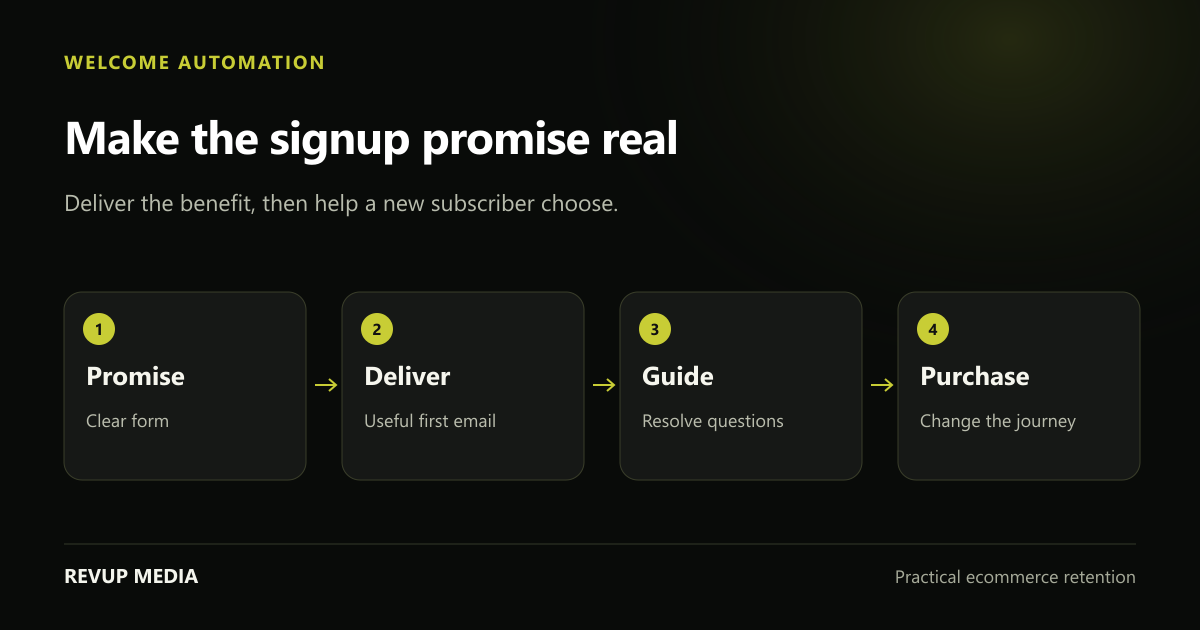
A Klaviyo welcome flow begins before the first email. The signup form creates an expectation, and the sequence should fulfil it while helping a new subscriber decide whether the brand and product fit their needs.
Start here
Deliver the promised benefit promptly, then reduce buying uncertainty. A welcome journey needs a clear customer exit and offer rules as much as it needs good design.
Write down the exact promise made by your signup form
List what the visitor saw: discount, early access, product guide, launch updates or another benefit. Record eligibility and any stated deadline. The first email should deliver that value clearly rather than bury it below a long founder story.
If the form promises a first-order discount, explain excluded products, minimum spend and whether the code can combine with other offers. If it promises a guide, provide the actual guide. If it collects early-access interest, explain when access opens and how the subscriber will hear about it.
Different signup sources can create different expectations. A sale form and an evergreen footer form may not need identical first-message framing. Use source data only when it is reliable and affects the experience; do not build elaborate branches around information you cannot consistently collect.
Choose the entry list and verify the new-subscriber path
A common Klaviyo email welcome series starts when someone is added to the chosen subscriber list. Ensure your forms route to the intended list and that the opt-in experience works as expected. A profile imported from elsewhere may not represent the same customer intent as a fresh storefront signup.
Test with a genuinely new email profile, including the confirmation path if your list uses double opt-in. Record how long it takes to receive the benefit. Then test an existing subscriber so you understand what happens when they submit the form again.
Keep email and SMS subscription experiences clear. A subscriber can be eligible for one channel and not the other. Avoid assuming an email signup authorises text messages or that one channel’s welcome journey should silently deliver the other channel’s promise.
Source and context: Klaviyo: creating an email welcome series ↗. Klaviyo documents the subscriber-list trigger and immediate first-message option. Verify your own form routing and opt-in behaviour before enabling the sequence.
Give each message one useful buying question
Plan the content around decisions rather than a predetermined email count. The first message delivers the benefit and explains what to do next. Another can help the subscriber choose a starting product. Later content can explain suitability, care, fit or another common objection.
Use credible evidence where it reduces uncertainty. A review should be genuine, relevant to the featured product and used with the appropriate permission. If you do not have a supported customer result, explain the product instead of inventing a claim. Brand story is useful when it clarifies why the product exists or how it is made.
A founder note can add a human voice, but it should still help the reader. Keep it concrete: what problem the founder noticed, what choice the brand made and where a new buyer can start. Avoid a long biography that delays the subscriber’s actual decision.
| Message job | What the subscriber learns | Primary next step |
|---|---|---|
| Deliver the promise | The benefit and exact terms | Use the benefit or access the resource |
| Help choose | The best starting options for their need | Visit the relevant product or collection |
| Resolve uncertainty | Fit, use, quality or delivery information | Make an informed buying decision |
| Explain a real deadline | When a genuine benefit expires | Act before the actual expiry |
Change the journey when the subscriber becomes a customer
Decide which messages should stop after the first purchase and which remain useful. A first-order reminder should not continue as though the customer has never bought. A product-care message may still be relevant, but it might belong in post-purchase instead.
Use purchase data to support a split or an exit where appropriate. Preview both paths. If a returning customer can subscribe through your form, ensure they do not receive an ineligible first-order offer. Explain an appropriate alternative only when the brand has actually approved one.
During Black Friday, compare the welcome offer with the public promotion. Choose the message that accurately explains the customer’s options. Do not leave an evergreen sequence promising a weaker benefit without context, or an expired seasonal benefit after the sale closes.
Choose timing around urgency and attention
Deliver time-sensitive signup value promptly. Subsequent messages can be spaced according to buying consideration, product complexity and subscriber response. A long-consideration product may benefit from education before another offer, while a simple consumable may need fewer steps.
Review the combined frequency across campaigns and flows. A person who signs up during a launch can be eligible for both. Decide whether the campaign offers new information or merely repeats the welcome message. Frequency settings should support a deliberate plan rather than substitute for one.
If you test the number or timing of messages, compare more than the final email’s revenue. Watch conversions across the journey, complaints, unsubscribes and buying behaviour. A longer sequence is not automatically a better welcome experience.
Use a release checklist and an improvement queue
Preview on mobile with images enabled and disabled. Make the benefit readable as text, use a clear main button and confirm that the landing page matches. Check names, optional profile fields, unsubscribe links, offer terms and product availability.
Place a test order after entering the flow and verify the intended exit. Test the discount in the actual cart with included and excluded products. Save the date of the review and the person responsible for maintaining the offer.
After launch, inspect entry, skip and delivery activity before redesigning anything. If qualified signups are missing, investigate routing. If customers click but do not order, inspect product choice and landing-page friction. If unsubscribes increase later in the sequence, evaluate whether those messages still provide a distinct benefit.
- New signup receives the promised value.
- Existing customers see appropriate terms and content.
- Purchase behaviour updates the journey correctly.
- Links, codes and mobile layouts work together.
Common questions
How many emails should a Klaviyo welcome flow include?
Use the number needed to deliver the signup promise and answer meaningful buying questions. Begin with a manageable sequence, then add a step only when it has a distinct purpose and evidence supports it.
Should every welcome flow offer a discount?
No. Early access, guidance or product relevance can be the benefit. If a discount is promised at signup, deliver it accurately and explain the conditions.
Need a plan for your store?
Turn the next useful idea into action.
We review your campaigns, flows, signup experience and customer journey to identify the work worth doing first.
Book Your Free Audit →Explore lifecycle flow planning →