Klaviyo segmentation · 6 min read
7 Klaviyo segments to plan before Black Friday, with message ideas and exclusions
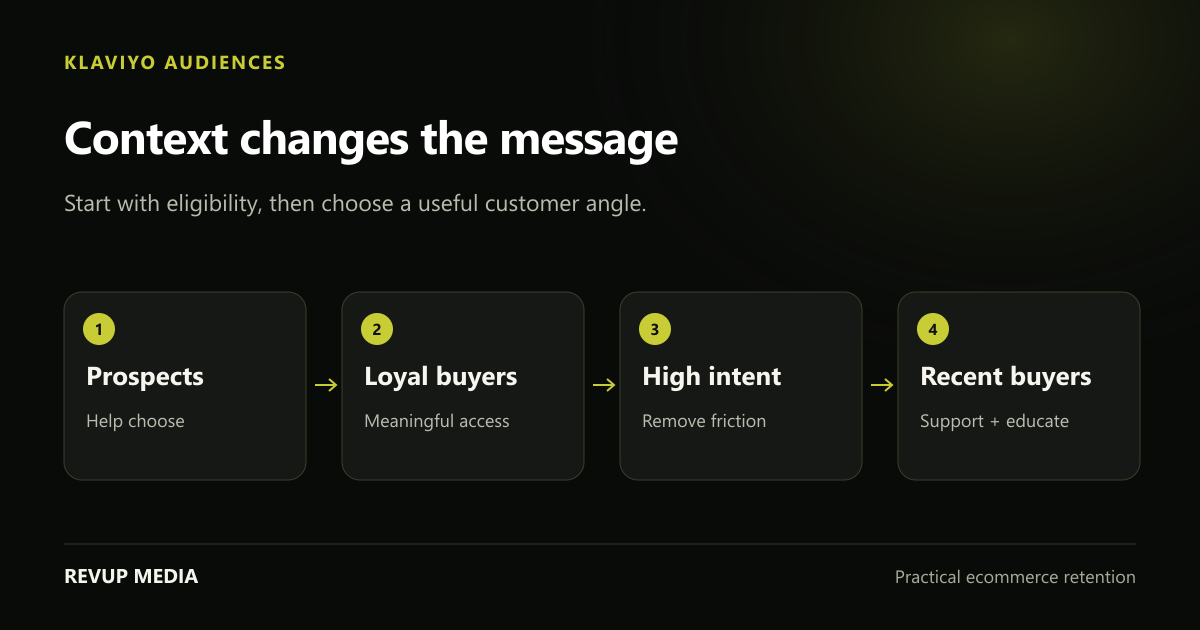
The best reason to create a Klaviyo segment is that it changes what a customer receives. These seven Black Friday audiences help ecommerce teams make that connection without building dozens of lists that all get the same sale email.
Start here
Every audience below starts with channel eligibility. The lookback windows and spend thresholds are examples to adapt, not universal Klaviyo settings or guaranteed winners.
Set a common eligibility base before adding conditions
Begin with customers who are eligible to receive marketing on the selected channel. Exclude suppressed profiles and honour consent and customer preferences. Then layer behaviour and purchase context on top. An email address appearing in your account is not, by itself, a reason to send a campaign.
For engagement, use reliable clicks, purchase activity and available site events alongside opens. Decide the lookback window based on your normal sending frequency and purchase cycle. A brand that sends weekly needs a different interpretation of “quiet” from a store that sends once a month.
Document your logic in plain language before building it. Pay attention to AND and OR groups: an OR condition placed outside the eligibility group can unintentionally admit an audience you meant to exclude. Preview members and inspect a few representative profiles before using a new segment.
1–2. New prospects and first-time customers
An engaged prospect has shown interest but has not bought. Use product guidance, a clear entry point and trustworthy buying information. The campaign should answer why this product is appropriate, not simply repeat the discount. One possible definition is eligible subscribers with zero orders and a recent click or tracked product interaction.
A first-time customer needs a different message. They already understand something about the product but may not have received or used it yet. Consider a relevant accessory, a guide or the benefits of a complementary range. Define recent first-time purchasers separately from older one-time buyers so you do not rush the same message to both.
For both groups, check the collision with automated flows. A prospect in a welcome sequence may receive similar content elsewhere. A new customer should stop receiving prospect-only acquisition messaging. Use exclusions or content changes deliberately rather than assuming campaign and flow eligibility always match.
- Prospects: show a best starting product, useful proof and exact sale terms.
- First-time customers: build confidence and introduce a relevant next step.
- Exclude purchases after the audience decision when the offer is explicitly prospect-only.
3–4. Loyal buyers and customers with category interest
Define loyal buyers using a measure you can explain: repeat orders, spend above a store-specific threshold, or a loyalty status your integration reliably supplies. Do not copy another brand’s VIP threshold without checking your own distribution. The benefit might be early access, an exclusive product, or a useful bundle rather than a larger discount.
Category-interest shoppers need evidence of interest that affects the offer. That could be a purchase in the category or recent browsing events where tracking is available. Avoid treating one accidental visit as a permanent preference. A recent skincare purchase, for example, can support a relevant routine message, while a broad bestsellers campaign may be less useful.
If someone qualifies for both VIP and category-interest audiences, decide which message wins. You can combine the context in one message or exclude the VIP segment from a category broadcast. The objective is a coherent experience, not more sends per qualified profile.
| Segment | Example evidence | Message difference |
|---|---|---|
| Loyal buyers | Repeat orders or verified loyalty status | Meaningful access or relevant member benefits |
| Category interest | Category purchase or recent tracked interest | Specific product guidance and collection link |
5–6. High-intent shoppers and lapsed customers
High-intent shoppers may have recently clicked a product email, added a product to cart or started checkout. Confirm which events your integration actually records. These signals are not interchangeable. A checkout-start event indicates a different stage from a collection-page visit.
This group is especially likely to overlap with abandonment flows. Review timing and purchase exits before layering a campaign on top. A useful broadcast might clarify shipping or product suitability, while the flow reminds the customer of their own cart. Identical reminders from both systems create unnecessary repetition.
Lapsed customers should be defined relative to a realistic repurchase cycle. Someone who bought a durable product three months ago may not be lapsed at all. If an old buyer is still eligible and has shown recent interest, a relevant product update may help. Do not use Black Friday to blast every long-inactive profile with an aggressive discount.
Source and context: Klaviyo Academy: BFCM segmentation strategies ↗. Klaviyo’s seasonal training supports using behavioural context to shape messages. The seven audiences and prioritisation process here are a practical planning framework rather than preconfigured platform segments.
7. Recent purchasers: a segment for protecting the experience
A recent-purchaser audience is useful even when you are not planning to send it another promotion. It can help you suppress an irrelevant final-hours reminder, explain a customer service policy, or provide onboarding. Use the order window that fits the offer and your fulfilment reality.
Do not automatically promise price adjustments or additional discounts. If your brand has an approved policy for purchases just before the sale, explain it accurately and link to the correct terms. If there is no such policy, offer support rather than inventing one in the email.
Separate customers who bought during the current sale from those who purchased shortly before it when that distinction changes the next message. During-sale buyers may need delivery guidance; earlier buyers may still have a sensible reason to shop for a different product. The message should reflect that context.
Test segment value without losing the comparison
Assign each segment a distinct hypothesis. For example: “A category-specific product guide will improve orders per recipient among recent category buyers compared with a general sale creative.” Keep the offer, send conditions and measurement window comparable if those are not the variables you are testing.
Track audience size, delivered count, clicks, placed-order activity, attributed revenue per recipient and negative feedback. Small segments can swing sharply from one or two orders, so avoid declaring a winner from an unstable result. If groups overlap, a raw side-by-side report may not describe a clean test.
After the sale, retain only segments that keep helping the customer or the team. Delete neither data nor history simply to make the workspace look tidy; retire unused campaign audiences through your normal account process. Your everyday segmentation strategy should be understandable to the next person who runs the channel.
Common questions
Should Black Friday segments use a 30-, 60- or 90-day engagement window?
Use a window suited to your usual cadence and buying cycle. Check size and representative profiles, then validate performance. There is no single window that suits every store.
Are lists and segments the same in Klaviyo?
A list is a collection of profiles; a segment is defined by conditions and updates as profiles meet or stop meeting them. Use the appropriate structure for subscriber collection versus behaviour-based targeting.
Need a plan for your store?
Turn the next useful idea into action.
We review your campaigns, flows, signup experience and customer journey to identify the work worth doing first.
Book Your Free Audit →Explore Klaviyo email marketing services →